
revised for the fourth of july, 2025

july 2023
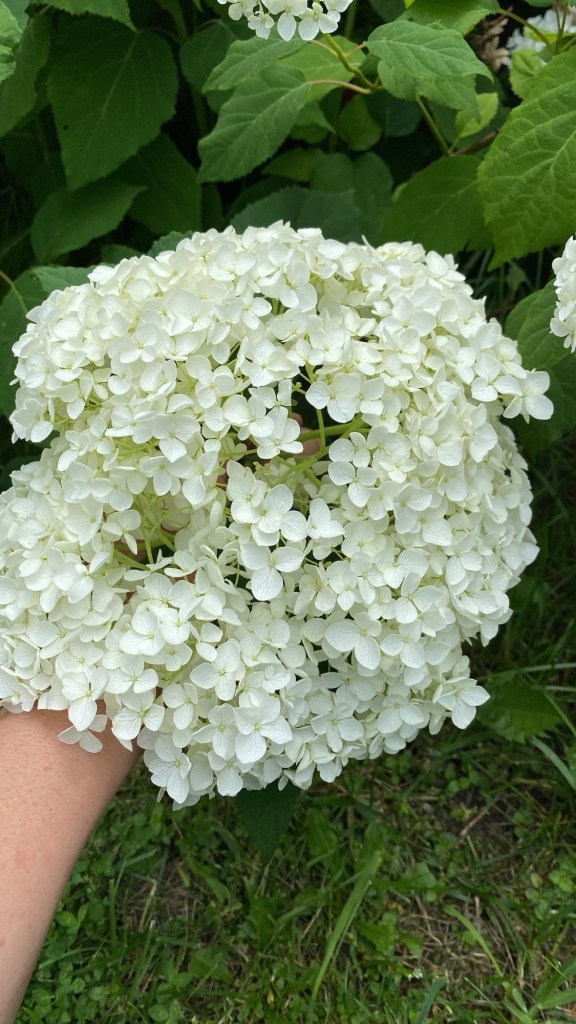
This Hydrangea nostalgia bush was grown from a 2017 autumn cutting from its parent which is, or was, located in the front yard of my brick 2-flat in the northwest side neighborhood of Portage Park in Chicago. One of a half-dozen or so white hydrangeas planted by me in the late 90s, I had nurtured and obsessed over them for nearly 23 years — this one is now the lone survivor in my care at my rural home in Michigan.
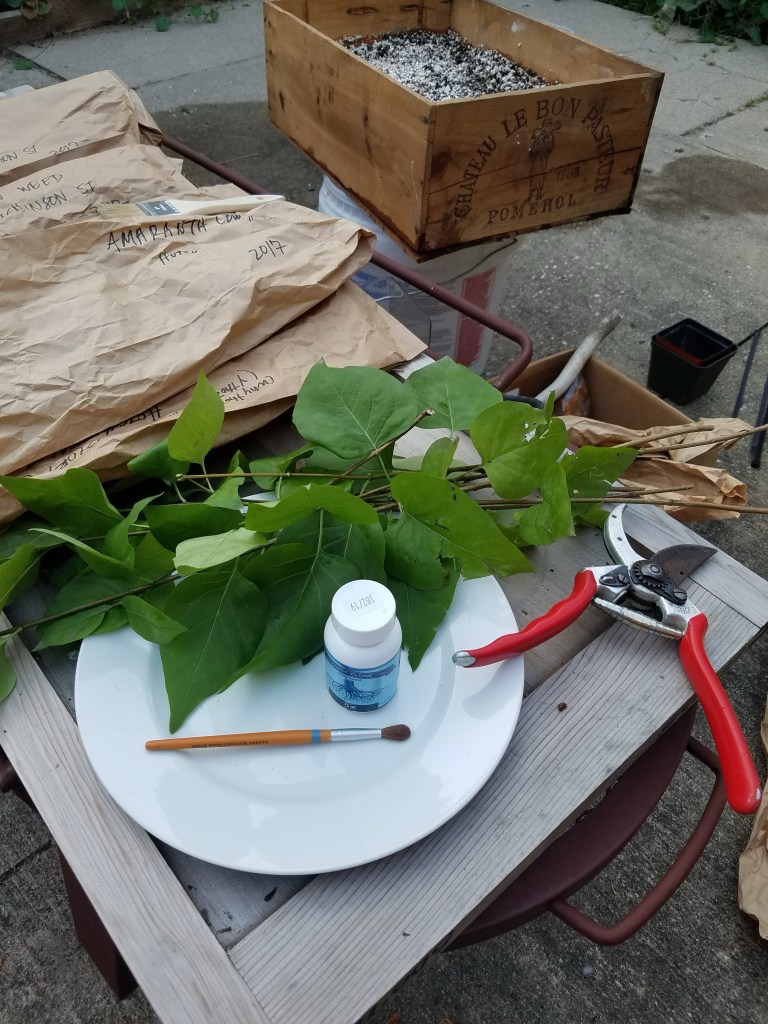
rooting hormone solution,
and growing medium,
September 23, 2017
(not even one of these most precious lilac cuttings rooted and survived)

autumn hydrangea & lilac cuttings,
not ideal for propagation,
but ready for transport and transplant
to Michigan
But the genesis of my city girl hydrangea devotion was not Martha Stewart’s ubiquitous “Living” magazine, also of 1990s — though she certainly named, informed, inspired and validated many a hydrangea obsession within those pages — rather, it was the nostalgic ubiquity of enormous white snowball blooms and arresting blue-purple poms on heritage shrubs that I admired, coveted, played and hid among during my childhood summers spent with my maternal grandparents in Murphysboro — a sleepy, rural town in Southern Illinois — where my maternal great, great grandmother, my great grandmother and grandmother were all born.
I was entranced by those plants each summer — yet without the language to name and fully describe them to my mother when I returned back home to the Chicago Housing Authority’s Lathrop Homes aka “the projects” – which usually, was just in the nick of time for back-to-school in late August. Interestingly, I don’t recall ever drawing a picture of hydrangeas or taking a photo of them with my hard-earned Kodak Instamatic pocket camera as a child – even though I frequently used both methods to capture/record my favorite things. //
“Nostalgia Kills”
Nostalgia is a psychologically pining for a sweeter but largely false time in our lives — a naive, shallow or ignorant time that we prefer to, that we choose to, remember as “innocence” or romanticize, idealize or distort as the “best times of my life” or the “good ol’ days”.
Instead of thoroughly revisiting the entirety of the time, place, people or experience, nostalgia often robs — or kills — the opportunity for true introspection and material dialectics. ///

Nostalgia sounds like the name of the a psychological condition catalyzed by avoiding “dis-ease”
Nostalgia in America most usually, almost always, can be deconstructed to a skeleton of marrow-less bones — one that may have always been devoid of real sustenance or support —
look closer, dig more deeply, and there is evidence of ugliness — or horror ////
The other day, as I listened to my friend wax nostalgic about her late, beautiful mother whom she still insists she reveres — our conversation organically segued into ancestors, dreams, magic and divination. She told me how when she was just twelve years-old, a mysterious fortune teller, a paid-in-cash-by-mail “psychic” correspondent in the Deep South seeded an awful lie about her to her mother in a “reading” sent to her mother by return letter; that repugnant lie; her mother’s belief in that repugnant lie; and her mother’s subsequent response to that repugnant lie — was unfathomable to me.
To my outsider-observer’s eye, that singular event appeared to be the catalyst for her entire life’s trajectory. //////
And, as I have learned myself, personally, you truly can never go “home” again — and even if you could, you probably wouldn’t want to
— returning to the beloved Murphysboro of my childhood summers and my hydrangea “ground zero” in the very early aughts as an adult with my own little boy — to share with him the quaint but impressive Fourth of July fireworks show, carnival and fresh lemonade that I had recalled so fondly — I was expecting something akin to the Gilmore Girls’ Stars Hollow. Instead, I was confronted by both a quiet, yet crystal clear racial segregation, and loud, ugly confederate imagery and sentiments of people and place.
Yes, the hydrangeas were still beautiful — my childhood memories hadn’t exaggerated their glory — they were indeed the grandest, bluest, purplest poms and behemoth, white flower-snowballs I had ever seen, anywhere.
But I had somehow forgotten, misplaced or buried the memory that my Black-American second father could never travel and stay there with me, my mother, and my grandparents out of their very legitimate fear of drawing the attention of the local chapters of the Klan
until that trip back, as an eyes-open adult, that is.
Then, a couple of years ago, in an amnesiac moment of nostalgia driving past my last, former home in Chicago — I surveilled the front yard from my car, did a double-take and then circled back around again — but I still wasn’t certain if the once-prolific hydrangeas I had planted and treasured had just been cut back to the ground for the season (i never cut them back, but many gardeners do) — or if they had been removed all together;
had someone actually not found them as beautiful as I had!? — did they not know that dried or snow-covered, the poms were lovely in fall and winter too! had they become infested or diseased and died; what happened to them?!
I don’t know if I will, or can ever drive past that house again — it’s a way for me to never know the fate of my hydrangeas —-
and to avoid further interrogation of myself and my own family — and the deaths, the endings, the ugliness and trajectories we experienced on that street. Of course, there was goodness and love there too — in both nostalgic and authentic abundance, ABUNDANCE, but what happened last is what inevitably sticks to the ribs and lodges in the mind.
Still, with all of my human heart, I hope that hydrangeas in their full July bloom will never cause anyone a smidgeon of anything other than eyesfull of stunning joy — I mean, how could they?
 the limineen | earthling, poet & crone