swish, swish, knock swish, swish, knock a rhythm, a metronome once a week, usually Sunday
you felt very near to me today, also a Sunday,
me weeping while sweeping, or vice versa
my movement conjured you, conjured the once-me and the eternally you/ me, looking down from the landing// you, nearing the top of the 2-flat stairs in your white t-shirt looking up over your thick glasses at me, with your big eyes with your snaggle-toothed smirk, mustached/ broom in your beautiful hands / pure lank, elegance
had i snapped a photo of you on them stairs with that look/
“… When the chips are down and for one reason or the other you begin to recognize that you are not going to be on this earth forever … your body is falling apart … you’ll be there and you’ll say: “I lived 60 years; I lived 70 years, or whatever it is; and I still don’t know anything; I don’t know where I came from, and more importantly, I don’t know where I am going; I don’t know anything mportant at all!! …
I’ve been so reasonable, I’ve been so rational, I’ve been so sober; and now I stand before the door, and I am shaking like a leaf, and I am scared and I am miserable, because I haven’t learned what is important; I haven’t learned the truth — the essence of my own being; I have not been confronted with any reality … I tried to fit into the picture so nicely.”
You know what – the picture that you tried to fit into is going away – from you… be there [at the door] and there’s no picture, no society, no family, none of the things that you thought were so important – just you and a great stupendous mystery which will remind you:
“From that time you came into this world, I was available to you to be discovered; I was available to you to be known with your gnosis, but you haven’t done it at all; you didn’t pay any attention – you went after the reasonable will–o’–the–wisp and the unreasonable will–o’–the–wisp, but you didn’t take a look at this [great mystery]!”
I think it’s only fair /warning/ to provide the last line, first:
“To know these ten principles of gnostic Christianity is to court disaster.”
“The Gnostic Christians of the second century believed that only a special revelation of knowledge rather than faith could save a person. The contents of this revelation could not be received empirically or derived a priori. They considered this special gnosis so valuable that it must be kept secret. Here are the ten major principles of the gnostic revelation:
“The Ten Major Principles of the Gnostic Revelation” (1978)
The creator of this world is demented.
The world is not as it appears, in order to hide the evil in it, a delusive veil obscuring it and the deranged deity.
There is another, better realm of God, and all our efforts are to be directed toward: a. returning there b. bringing it here.
Our actual lives stretch thousands of years back, and we can be made to remember our origin in the stars.
Each of us has a divine counterpart unfallen who can reach a hand down to us to awaken us. This other personality is the authentic waking self, the one we have now is asleep and minor. We are in fact asleep, and in the hands of a dangerous magician disguised as a good god, the deranged creator deity. The bleakness, the evil and pain in this world, the fact that it is a deterministic prison controlled by a demented creator causes us willingly to split with the reality principle early in life, and so to speak willingly fall asleep in delusion.
You can pass from the delusional prison world into the Peaceful kingdom if the True Good God places you under His grace and allows you to see reality through His eyes.
Christ gave, rather than received, revelation; he taught his followers how to enter the kingdom while still alive, where other mystery religions only bring about anamnesis: knowledge of it as the “other time” in “the other realm,” not here. He causes it to come here, and is the living agency of the Sole Good God (i.e. the Logos).
Probably the real, secret Christian church still exists, long underground, with the living Corpus Christi as its head or ruler, the members absorbed into it. Through participation in it they probably have vast, seemingly magical powers.
The division into “two times” (good and evil) and “two realms” (good and evil) will abruptly end with victory for the good time here, as the presently invisible kingdom separates and becomes visible. We cannot know the date.
During this time period we are on the sifting bridge being judged according to which power we give allegiance to, the deranged creator demiurge of this world or the One Good God and his kingdom, whom we know through Christ. To know these ten principles of gnostic Christianity is to court disaster.”
Selections from “The Exegesis” By Philip K. Dick
Ashes to Light.
Lent (n.)
“period between Ash Wednesday and Easter,” late 14c., short for Lenten (n.) “the forty days of fasting before Easter” in the Christian calendar (early 12c.), from Old English lencten “springtime, spring,” the season, also “the fast of Lent,” from West Germanic *langitinaz” long-days,” or “lengthening of the day” (source also of Old Saxon lentin, Middle Dutch lenten, Old High German lengizin manoth). This prehistoric compound probably refers to increasing daylight in spring and is reconstructed to be from *langaz “long” (source of long (adj.)) + *tina- “day” (compare Gothic sin-teins “daily”), which is cognate with Old Church Slavonic dini, Lithuanian diena, Latin dies “day” (from PIE root *dyeu-“to shine”).
Compare similar form evolution in Dutch lente(Middle Dutch lentin), German Lenz (Old High German lengizin) “spring.” But the Church sense is peculiar to English. The -en in Lenten(n.) was perhaps mistaken for an affix.
my eyes stigmata overflowing saltwater corresponding heartache of this life, heartbreak of this world,
this cross of water, women carry
here i am
creating fresh watersheds from my headwaters/ my tears runoff into wrinkle streams/ flowing tributaries converge into rivers desalinated in sediment of flesh/ creases of time and depth weather my face/ carved canyons carry rapids down my cheeks/ raging confluence pours into the lake of my mouth, onto bed of my tongue/ spilling waterfall down my throat into ocean of my heart/
I could not live in any of the worlds offered to me…the world of my parents, the world of war, the world of politics. I had to create a world of my own, like a climate, a country, an atmosphere in which I could breathe, reign, and recreate myself… That, I believe, is the reason for every work of art. The artist is the only one who knows that the world is a subjective creation, that there is a choice to be made, a selection of elements. It is a materialization, an incarnation of his inner world.
Anais Nin
Here she stopped and, closing her eyes, took a deep breath of the flower-scented air of the broad expanse around her.
It was dearer to her than her kin, better than a lover, wiser than a book.
[For a moment] she rediscovered the purpose of her life.
She was here on earth to grasp the meaning of its wild enchantment and to call each thing by its right name …
Boris Pasternak, Doctor Zhivago
As soon as you are really alone you are with [the] God[head].
a man who knew my father befriended me and caused me to question the nature of my reality, my history, its validity, my possibly-false memories — all, viewed through the lens of the person who had a vested interest in indoctrinating me who preferred my naïveté under the guise of protectivity
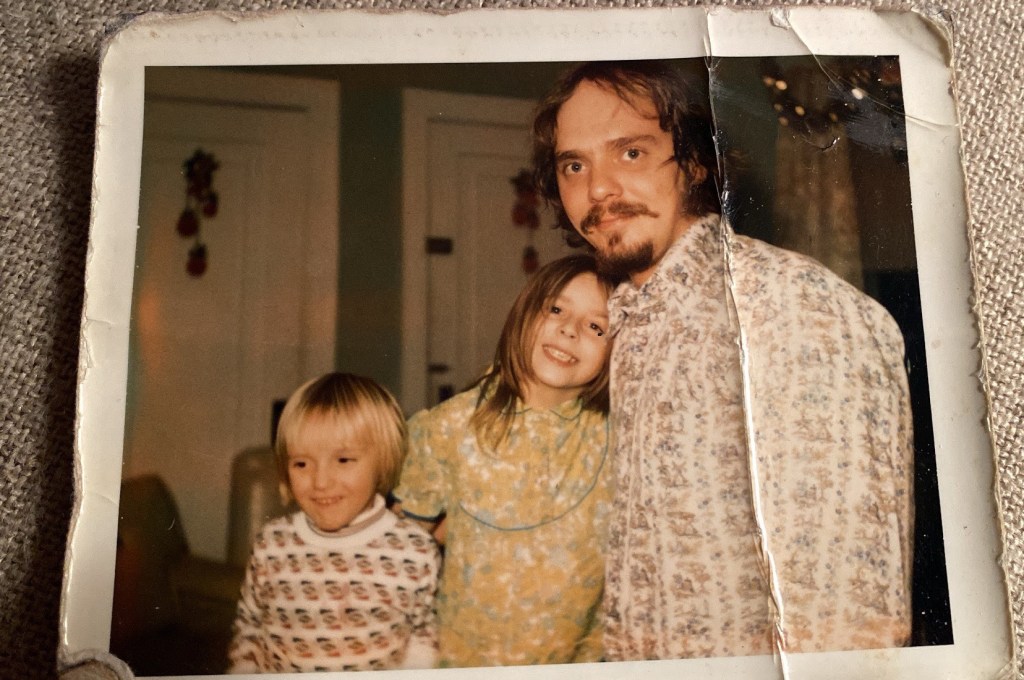
my last photo with my father, Christmas break, age 6, Waukegan, Illinois
parents can write stories on the folds of a child’s cerebrum, their pens go unchallenged until they’re challenged / their ink is like cord blood, except it can re/generate — or damage
but it only takes one person to crack their sky, then, we astronomers spend our lives asking these zealots the non-answerable “why?”
long, midnight, blue-black hair, unmistakably hers, melding into her pitch black jacket an uninterrupted flowing river of velvet she, a radiant silhouette,
like the haloed total solar eclipse that would occur later that year, in August
her regal face remains unseen, sustaining the mystery
then she rises like a sun to speak, and i am in her orbit
her first words: “i feel The Lake so very present in me.”
her voice ancient with the Earth in her throat
later, my glisteny eyes meet her glisteny eyes, i memorize her face, and her hands tattooed in black ink
she is dignity embodied, i think
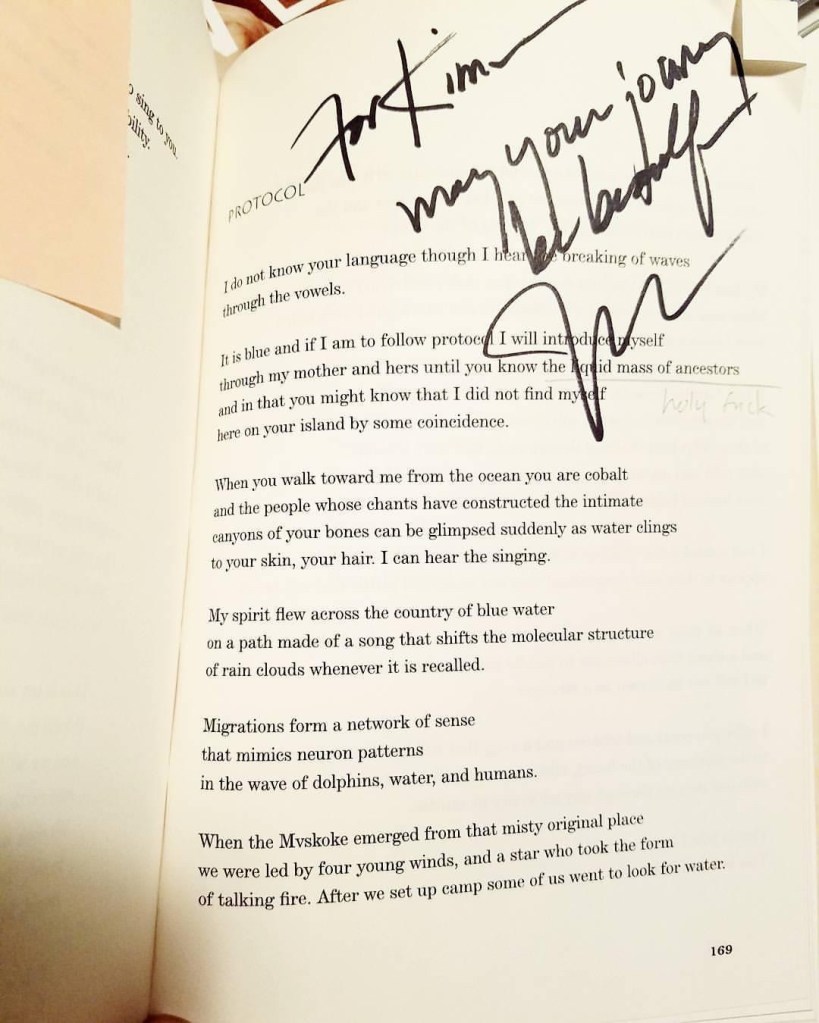
she inscribes a protocol for me in my book of hers, made from trees,
i give her a cord necklace suspending glass vials of seeds watermelon, corn, clover and milkweed from my garden in these forced-treaty lands, an onion field once, a portage between two rivers
a reciprocity for her words that seeded me, collaterally,
her poetry an eternal spring watering my thoughts and words
this poem is inspired and directly derived from a dream i woke up from/with
on February 15, 2023
and is an experiment of raw dreaming dialogue and internal dreaming monologue to express the dreamt experience in poetic format using minimal metaphoricphrasingand language
a familiar woman sitting on the couch in your house asks me how many hours do you have to yourself i am perplexed: “all of them” they’re all my hours
the roof begins leaking the one you fixed last year the one i was reading under while she asked me about my hours i noticed when the book suddenly became smattered with rain drops water drops or raindrops, what’s the difference
it was a Rugrats coloring book i don’t know what page i was on but Angelica was waiting to be colored-in and one of the boys was saying “mommy” in a speech bubble it must’ve been a thought bubble because the Rugrats, except for Angelica, are not verbal
thaw with love lettersimpermanence semi-permanencebe mine.love, American stylefind you someone who looks at you the way mary hatch looks at george bailey Continue reading “the ides of february”→