
first in a series
The Entrance Gate on the far bank of The River Tuoni according to the Kalevala and as depicted by Finnish artist Hugo Simberg
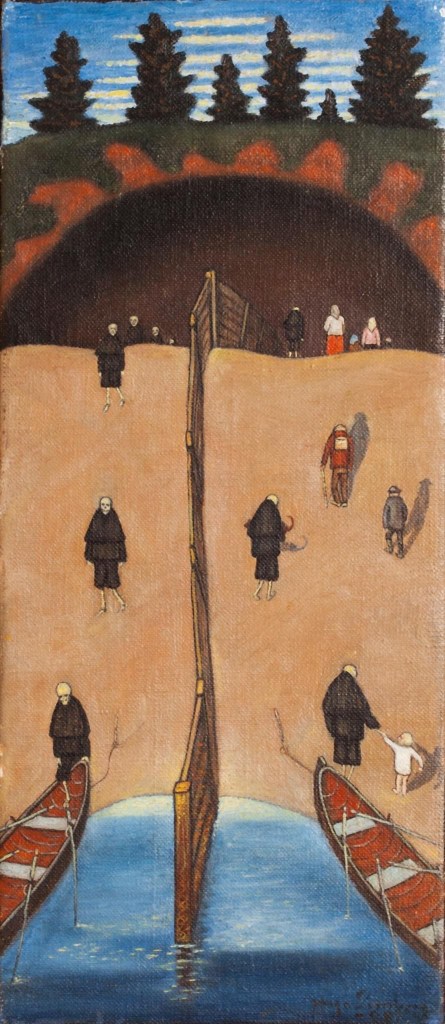
oil on canvas
Hugo Simberg, 1873-1917
Finland
In this piece, which is an interpretation of one of many universal myths which impart the water crossing and trek we all are to embark upon after death,
most of the departed climb up the steep, barren embankment and enter the tunnel individually, while a child and a dog are tenderly escorted — led by the hand or carried by chthonic monks into the tunnel leading to the
Underworld
the tunnel appears under geological strata — presumably the surface of Earth, with blue sky and forest in background above it
interestingly, the artist’s limited use of perspective also allows the sky and forest to be viewed potentially as the Great Beyond itself — as a Northern or Alpine “paradise,” a Valhalla, beyond the sojourn in and through the tunnel
a high, solid, wooden fence bisects the river, embankment and tunnel and prevents arrivals from observing the exiting monks — only one-way vision and traffic for the dead
and while the monks do not cast shadows, the human figures continue to be accompanied by their shadows; for those who subscribe to Jungian analytical psychology or gnostic texts, the physical shadow depicted may be interpreted symbolically as the anima/animus of the person — which would ultimately disappear during the tunnel upon the full reintegration of the Self/Soul/Spirit
through re-unification with one’s divine twin (which is sometimes also called the cosmic/celestial twin or daimon) after having been separated during human incarnation and birth.
author’s note:

i often and prefer to call the underworld aka afterlife “The Great Wide Open of the All” — which in my liminal gleanings is a supremely contented blackness of universal consciousness, devoid of thought or sensation — a perfected existence in the dark cosmic fabric of nothingness,

there may be levels in the afterlife which may manifest our own personal imaginal constructs of paradise — far beyond what our limited sensory perception and experiences of life on Earth are - such as, an Alpine Paradise upon emerging from the tunnel -

i know full well the breathtaking beauty and feeling upon exiting a scary and lengthy mountain tunnel where my heart and eyes are stunned by a grand vista of forest, peaks and sky — from my many road trips in the Western U.S.

yet, i truly prefer the former — when i die, i want to rest for all eternity — although with just one desire, one sensation: warmth.
Continue reading “art appreciation: thresholds”
 the limineen | earthling, poet & crone