Shepard Fairey is back on his bullshit

“Question Everything,”

then Obey!
fool me once, mfer.

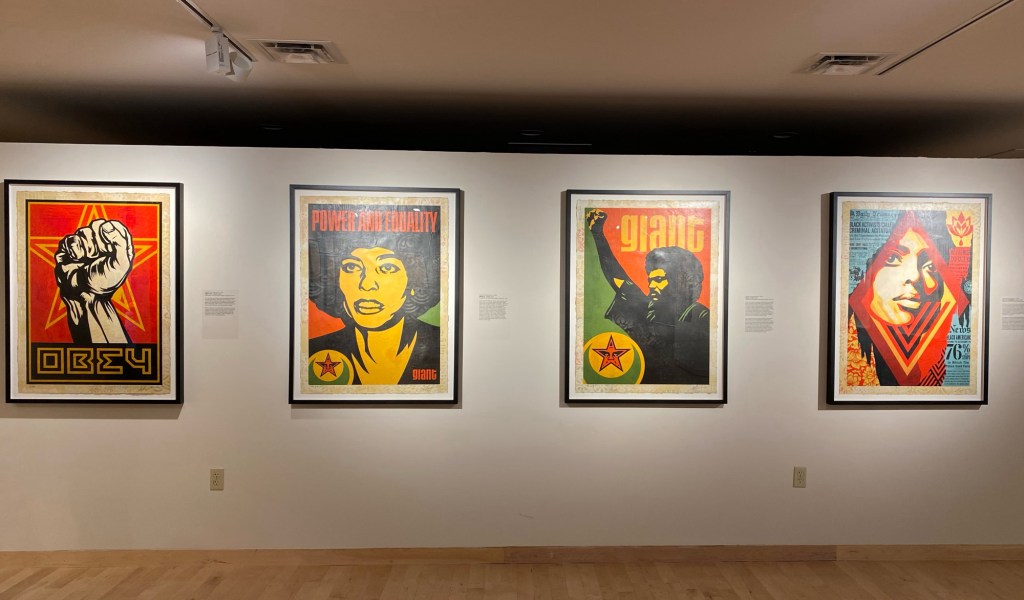
This past Spring, I saw a Shepard Fairey exhibit at the local art museum: Shepard Fairey: Facing The Giant: 3 Decades Of Dissent.
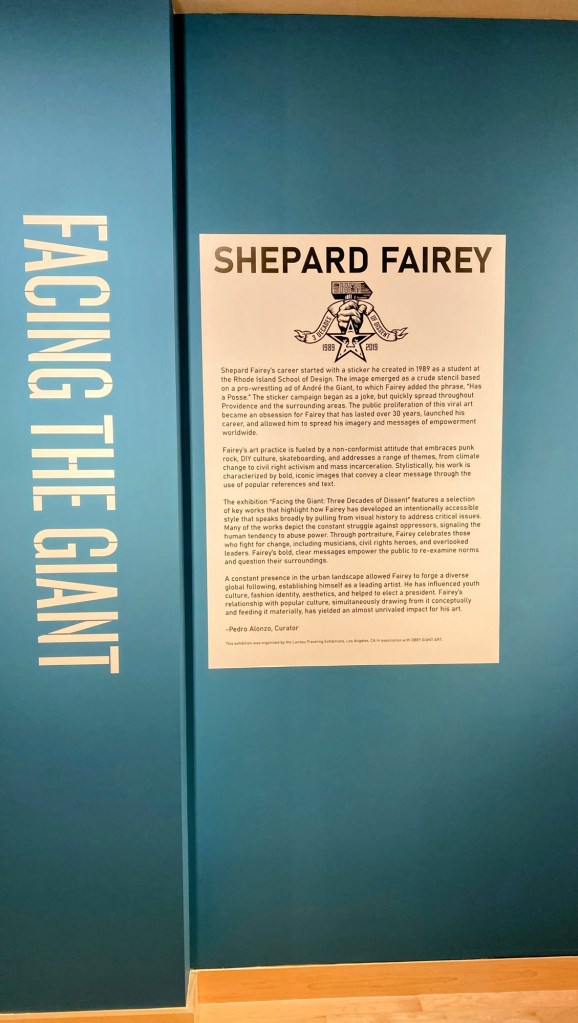

fwiw: admission to the Krasl Art Center is free.
I didn’t pay to enter the exhibit.

Shepard Fairey no doubt has a seminal presence in street art — that is, art in public space — in sticker culture, in wheatpaste postering and in muralism. But, he’s also problematic as fuck — problematic to “fair use”, to social movements — and to art itself. I want to be more precise and say: he has an ejaculative presence in art in public space: his stuff is ubiquitously and frequently splattered — and sticky in the public consciousness — like a true Mad Men, note Ad men and marketers and PR consultants are not artists: they are not even tricksters — they are influencers, marketeers, cons, liars and grifters.

Fairey perhaps most famously helped to elevate Barack Obama’s first presidential campaign with his iconographic HOPE image — Fairey, (perhaps) like tens of millions of us, including myself, bought into Obama’s community organizer/activist history and “hope and change” schtick back in 2008. The shame and pain of decades of systemic, racialized disenfranchisement and inequity were transformed into an incredible electoral energy that was earnestly and hopefully deposited into Obama’s candidacy and presidency; it was then almost immediately disregarded and wasted — and ultimately, profoundly regretted by progressives. Only after his first term was nearly complete did “we” learn and process that Obama was a neo-liberal capitalist centrist cloaked in folksy voice and progressive-populist clothing — we witnessed him betray us again and again — and become a prolific drone-strike-executioner-in-chief as well as Wall Street’s and Rahm Emanuel’s punk-ass bitch.

I want to be more precise and say: he has an ejaculative presence in art in public space: his stuff is ubiquitously and frequently splattered — and sticky in the public consciousness.

The Obama HOPE image stands as a reminder and a joke of hope placed in any Democrat or Republican politician — any. Thank you for that, truly, Shepard Fairey.

But, some among us may still not know — that Fairey had misappropriated the photograph on which the iconic Obama HOPE poster was based, without credit or compensation to the copyright holder — falsely citing “fair use” — Fairey subsequently destroyed evidence about the actual unfairness of his use which amounted to theft, fraud and obstruction. Fairey settled with the copyright owner and also plead guilty for contempt of court.

Fairey has also reproduced and exhibited images of actual, bonafide Black power and liberation icons (Angela Davis notwithstanding) — and has been rightly interrogated about his cultural appropriation. On the surface, his work may pass as homage to great People and powerful movements, but it can also be interpreted as an artistic “black face” — and as an attempt to co-opt that which is not his in order to elevate his own vanilla, half-woke vibe — and of course, to cash-in. He remains defiant in his approach to cultural appropriation.


Continue reading “Shepard Fairey is back on his bullshit”
“PALESTINE IS THE WORLD IN ITS FUTURE TENSE”

Art Not Genocide Alliance manifesto
as distributed and posted at the April 2024
Venice Biennale
to protest the inclusion of and to demand the boycott of the Israeli Pavilion
aka The Genocide Pavilion

NO BUSINESS AS USUAL

DURING GENOCIDE


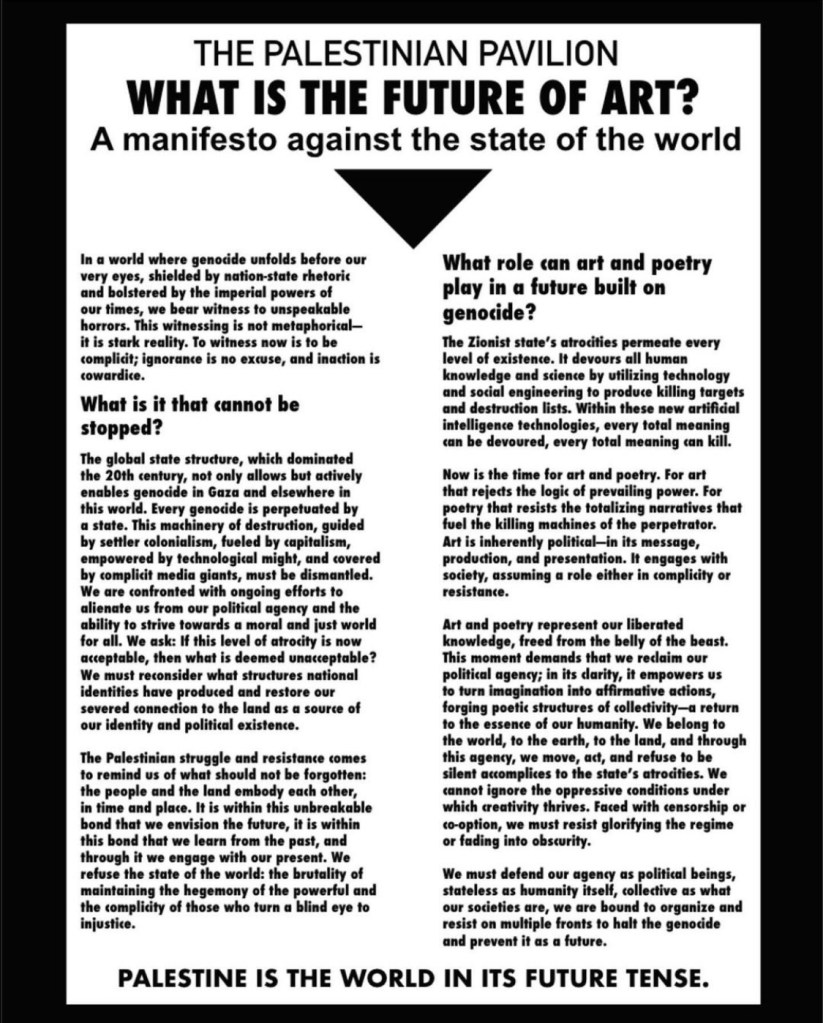
THE PALESTINIAN PAVILION

WHAT IS THE FUTURE OF ART?

A manifesto against the state of the world.


In a world where genocide unfolds before our very eyes, shielded by nation-state rhetoric and bolstered by the imperial powers of our times, we bear witness to unspeakable horrors. This witnessing is not metaphorical – it is stark reality. To witness now is to be complicit; ignorance is no excuse, and inaction is cowardice.

What is it that cannot be stopped?

The global state structure, which dominated the 20th century, not only allows but actively enables genocide in Gaza and elsewhere in this world. Every genocide is perpetuated by a state. This machinery of destruction, guided by settler colonialism, fueled by capitalism, empowered by technological might, and covered by complicit media giants, must be dismantled. We are confronted with ongoing efforts to alienate us from our political agency and the ability to strive towards a moral and just world for all. We ask: If this level of atrocity is now acceptable, then what is deemed unacceptable? We must reconsider what structures national identities have produced and restore our severed connection to the land as a source of our identity and political existence.

The Palestinian struggle and resistance comes to remind us of what should not be forgotten: the people and the land embody each other, in time and place. It is within this unbreakable bond that we envision the future, it is within this bond that we learn from the past, and through it we engage with our present. We refuse the state of the world: the brutality of maintaining the hegemony of the powerful and the complicity of those who turn a blind eye to injustice.

What role can art and POETRY play in a future built on genocide?

The Zionist state’s atrocities permeate every level of existence. It devours all human knowledge and science by utilizing technology and social engineering to produce killing target and destruction lists. Within these new artificial intelligence technologies, every total meaning can be devoured, every total meaning can kill.

Now is the time for art and poetry. For art
that rejects the logic of prevailing power. For poetry that resists the totalizing narratives that fuel the killing machines of the perpetrator. Art is inherently political-in its message, production, and presentation. It engages with society, assuming a role either in complicity or resistance.

We must defend our agency as political beings,
stateless as humanity itself, collective as what
our societies are, we are bound to organize an
resist on multiple fronts to halt the genocide
and prevent it as a future.

Art and poetry represent our liberated knowledge, freed from the belly of the beast. This moment demands that we reclaim our political agency; in its clarity, it empowers us to turn imagination into affirmative actions, forging poetic structures of collectivity-a return to the essence of our humanity. We belong to the world, to the earth, to the land, and through this agency, we move, act, and refuse to be silent accomplices to the state’s atrocities. We cannot ignore the oppressive conditions under which creativity thrives. Faced with censorship co-option, we must resist glorifying the regime or fading into obscurity.

Continue reading ““PALESTINE IS THE WORLD IN ITS FUTURE TENSE””

“[S]he floats like a butterfly …”


Muhammad Ali diptych
marker, paint, glue and chunky gold glitter
on 12”x12” square
gold metallic cardstock

These two gorgeous, requested works by the most gorgeous and extraordinary artist and person Mz. Lajuana Lampkins of Chicago.

You might find her making her art in the late night scene of her favorite spots in the Wicker Park/Bucktown neighborhoods of Chicago — or reach out to her on Instagram at Lajuana.Lampkins1 and peruse her art, her process and her community.

Lajuana Lampkins has had her art exhibited to great praise; she is a prolific and widely collected street artist; and she has edited and published a book of her late son’s essays, poetry and letters: The Collected Works of Prince Akbar AKA Jus Rhymz.

She is also a sister, aunt, friend, poet, community member and activist, writer, rapper, historian, archivist, fashionista, paralegal, social commentarian and modern philosopher — but most proudly, a mother, grandmother and great grandmother

— and to me, she epitomizes the Crone.


Champions aren’t made in the gyms. Champions are made from something they have deep inside them: a desire, a dream, a vision. They have to have last-minute stamina, they have to be a little faster, they have to have the skill and the will. But the will must be stronger than the skill.

Muhammad Ali

Mz. Lampkins works may be exhibited again in autumn 2023 in a community art show that she is hoping to create and develop —-and she aspires to publish her next non-fiction book in the nearer future.

She is also the subject of the forthcoming documentary “My Mother is An Artist” which follows Mz. Lampkins’s journey from 2019, eight years post-release from a 30 year incarceration as a wrongfully prosecuted and convicted young woman and mother —to 2023, as a working, locally-renown and yet-still-struggling artist living in these American systems of modern oppression and exploitation.

Continue reading ““[S]he floats like a butterfly …””

The Song of The Lark

The Song of the Lark has always been one of my very favorite works of the French naturalists – the gorgeous, day-glo, corally-salmon Sun and the woman’s arrested and reverent attention — her ear-witness to the birdsong — she reminds me of myself on any given day at golden hour — dawn or dusk //

while most criticism — almost all criticism of this work agrees that this painting depicts a woman at dawn — at Sun’s rise: i’m not wholly convinced.

i have experienced Jules Breton’s “The Song of The Lark” twice in two separate exhibits — at its home in the collection of The Art Institute of Chicago; and most recently, in 2015, at the University of Nebraska’s Sheldon Museum of Art for “Visual Cather: The Writer’s Pictorial Imagination” — where i was able to linger a mere foot away from the painting, studying it, for as long as i wanted — i stayed there for a reverent half hour in its glow.

Visual Cather:
The Writer’s Pictorial Imagination

Author Willa Cather spent her formative years in Nebraska and was an alumnus of the University of Nebraska; her third novel, published in 1915, was named for Breton’s painting — The Sheldon was a natural recipient for a loan of this magnetic artwork ///

while viewing the painting at The Sheldon, i conversed and queried with the fellow-Chicago-born docent — the only other person in the gallery:

will the lark sing their song most sweetly or urgently at sunrise or sunset?

does this work actually depict a neon sunset in the west; or is it, in fact, a day-glo sunrise in the east?

DayGlo color, pigment, paint would not be invented and commercially available until the 1930s — yet, Breton painted his glorious Sun in 1884 — he had already figured out the recipe ///

and, is the woman’s fatigue residual — from yesterday — she, a worker rising so very early, again, — or, might it be fatigue from a just-completed long and hard day’s work under the Sun?

i asked the docent the rhetorical questions i had been silently asking myself.

is it both? it’s both? it’s both.

let the mystery be*

Continue reading “The Song of The Lark”