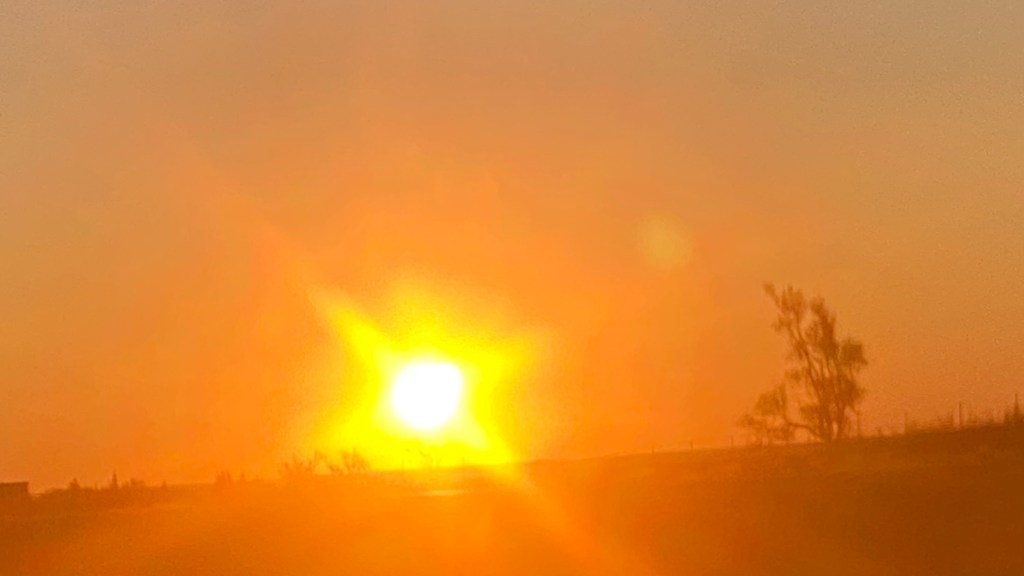
the almost-surreal beauty of the evening of the 29th day of April, 2024 CE Cenozoic Era Quarternary Period Anthropocene Epoch Michigan, North America
“Why is the World so beautiful?” asks, Dr. Robin Wall Kimmerer.
It didn’t have to be — the Earth could’ve been Big-Banged out into a uniform, utilitarian and dull rocky planet — evolving without bluebirds, banana trees and bioluminescent jellyfish — or April’s apple blossoms, golden-pink sky Sunsets, and frog choruses,
the Sun just keeps on shining setting and rising, setting and rising while the People of Palestine, of Congo, are genocided
the deception of the “life-bringer” Sun on yet another day of genocides
did you know that Yaldaboath only feigned dismay when Cain blew his own brother away; then He later told Abraham to kill his own son, just to prove that he was obsessed enough
you know, that dear Jesus in heaven comfortably stayed all throughout the Trans-Atlantic slave trade,
and that Allah had no problems with the Caliphates and The One True God was all about The Crusades
and that Creator ignored the prayers and the pleas of First Peoples slaughtered by steel, starvation, and European disease
and that Yahweh was pre-occupied during the Holocaust busy planning and inciting the Palestinians’ cruel loss
from Auschwitz to Al-Shifa, He so craves burnt offerings His global portfolio — built solely on dead things
He created the Sun to grow His tainted Seeds Horror by daylight, His Grand Design? — what a fucking death scheme
Auden once begged to “dismantle the Sun” for the loss of his own be-loved one
but Hark!
for the loss of our collective soul, dismantlement’s just not good enough, leave Him no parts, no plans to re-build and restart!
"[S]he said that a [hu]man had to escape to the country to see the world whole and that [s]he wished [s]he lived in a desolate place like this where [s]he could see the [S]un go down every evening like [the] [g]od[head] made it to do."

~ Flannery O’Connor
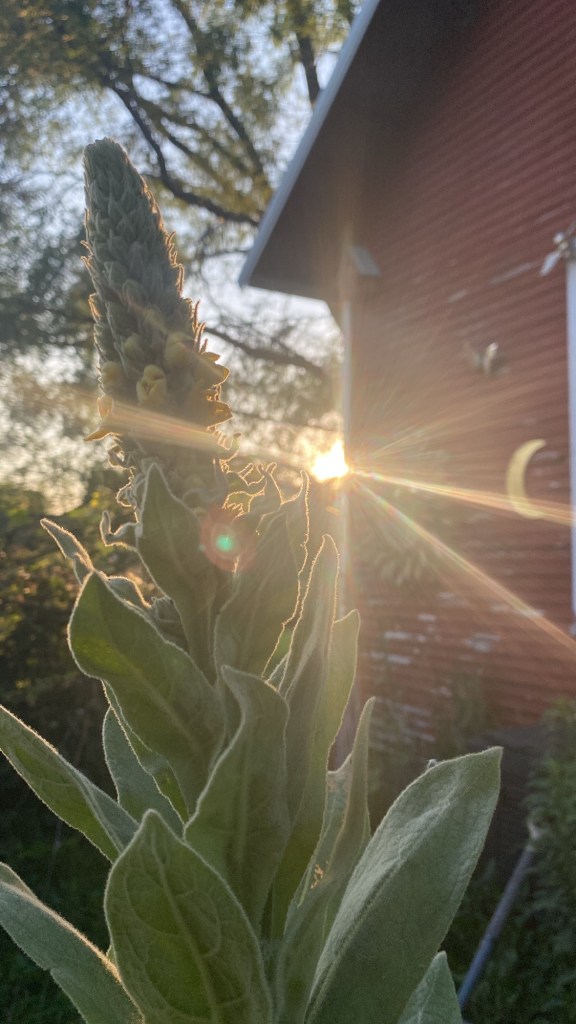
Deer and Bird and Frog People in the Limineen of light and dark as witnessed in The Great Lakes of the North american continent April 11, 2023
The Song of the Lark has always been one of my very favorite works of the French naturalists – the gorgeous, day-glo, corally-salmon Sun and the woman’s arrested and reverent attention — her ear-witness to the birdsong — she reminds me of myself on any given day at golden hour — dawn or dusk //
while most criticism — almost all criticism of this work agrees that this painting depicts a woman at dawn — at Sun’s rise: i’m not wholly convinced.
i have experienced Jules Breton’s “The Song of The Lark” twice in two separate exhibits — at its home in the collection of The Art Institute of Chicago; and most recently, in 2015, at the University of Nebraska’s Sheldon Museum of Art for “Visual Cather: The Writer’s Pictorial Imagination” — where i was able to linger a mere foot away from the painting, studying it, for as long as i wanted — i stayed there for a reverent half hour in its glow.
Author Willa Cather spent her formative years in Nebraska and was an alumnus of the University of Nebraska; her third novel, published in 1915, was named for Breton’s painting — The Sheldon was a natural recipient for a loan of this magnetic artwork ///
while viewing the painting at The Sheldon, i conversed and queried with the fellow-Chicago-born docent — the only other person in the gallery:
will the lark sing their song most sweetly or urgently at sunrise or sunset?
does this work actually depict a neon sunset in the west; or is it, in fact, a day-glo sunrise in the east?
DayGlo color, pigment, paint would not be invented and commercially available until the 1930s — yet, Breton painted his glorious Sun in 1884 — he had already figured out the recipe ///
and, is the woman’s fatigue residual — from yesterday — she, a worker rising so very early, again, — or, might it be fatigue from a just-completed long and hard day’s work under the Sun?
i asked the docent the rhetorical questions i had been silently asking myself.





 the limineen | earthling, poet & crone