i am making a marinara, but i may pivot and make it a vegan bolognese, served over bucatini or vegan mushroom or eggplant ravioli.
i haven’t yet decided — while children are being genocided
by intentional starvation
in Gaza, Palestine.
there is famine in Sudan. And Congo. And Ethiopia, too.
how is this real life?
in 2024, while The World can watch from their screens. while knowing there is enough food in The World for all of them.
yet, here, i am deciding: between listening to a podcast about one of my favorite fellow outer-ruralers, Ted Kaczynski (the irony is not lost) — or, a pandora station mashup of caamp and uncle lucius – both bands, i first learned of from time with my son in wondrous and humbling wilderness landscapes and cozy lodging — or, continuing my Clarissa Pinkola Estes audio bookthe Power of the Crone Myths & Stories of the Wise Woman Archetype //
so many choices for dinner, intellectual stimulation or joy while i am safe and warm and mostly, whole.
how does this dichotomy exist?
that is rhetorical.
i feel the grief of helplessness most acutely when i am in the grocery store shopping for food and while i am preparing and cooking food — the most basic of human tasks //
a meadow in Michigan, The World.
this is a foto of golden-rosy light shining on the snow-covered meadow that i have the immense privilege to nurture, protect and observe, on land i occupy — at Sun’s peaceful, not violent, rise this morning — the precious snow all melted by afternoon
Crone tip :
when you glimpse the blaze of golden-rosy light, you must act instantly:
get to the window, get outside, with or without an artificial lens or shoes — because the glow is gone in less than minutes.
HumanEarthling tip:
when you glimpse a genocide and famine you must act instantly:
you must speak out, loudly; you must resist in all possible ways; you must refuse to look away as you live life; you must do something, anything, to try and stop it; you must do anything, something to try and help other Earthlings; you must resist and “refuse to be an accomplice to genocide.”
Our World sits just outside of Gaza, of Palestine. We are All in the zone of interest, right now.
fresh snow, a perfect medium for the long shadows cast by the house & black walnut tree, under the high and full Snow Moon of predawn february 24, 2024
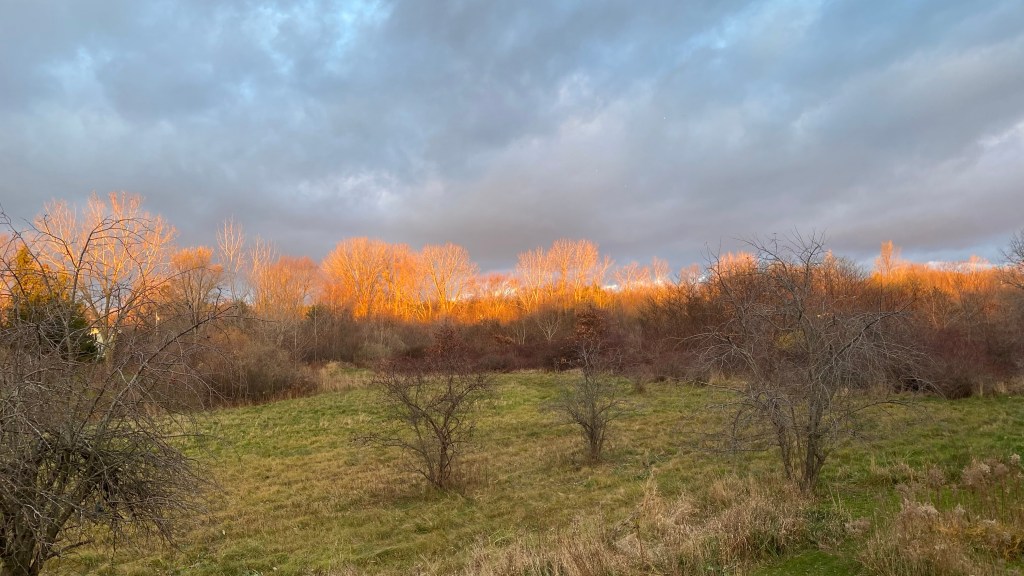
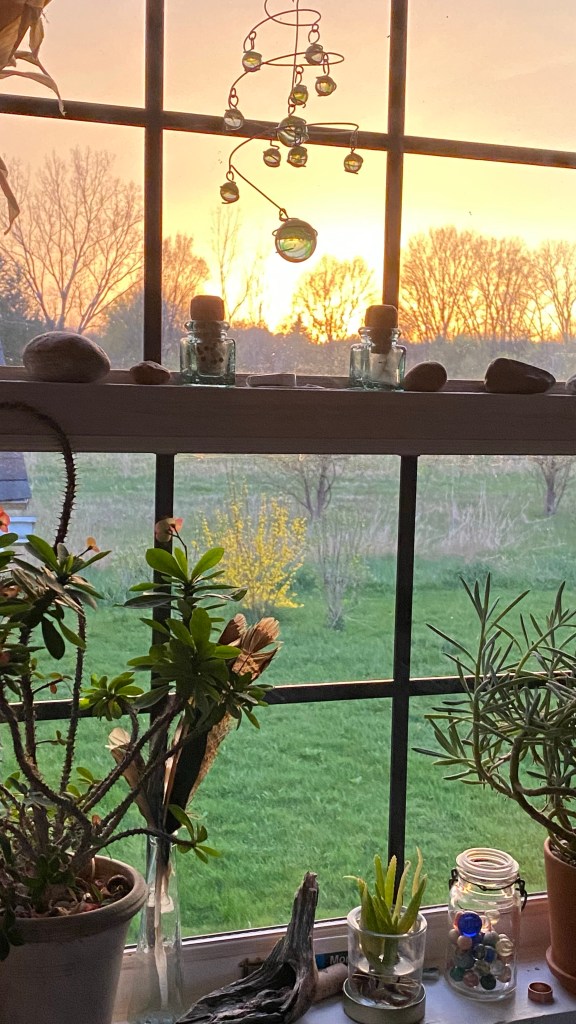
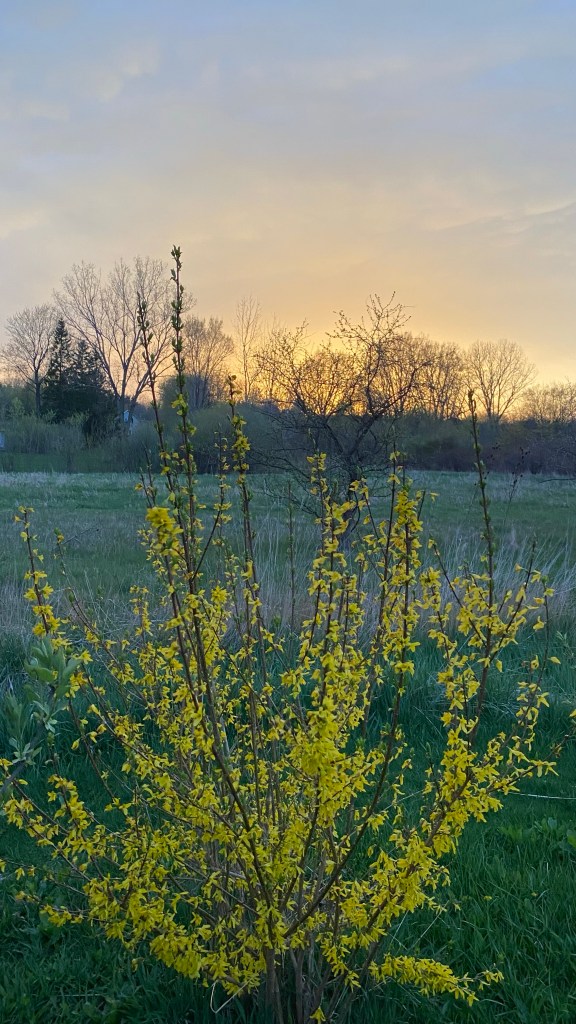
the golden light stole her attention, as per halted her forward motion, as per the Sun’s set would be the first without Her, earthside she took some photos, as per,
/but also, to remember that very first one/
she then acknowledged that the Sun, Moon and Stars herald no one’s birth, announce no one’s death and perhaps that’s why the Star of Bethlehem and a midday eclipse
The Song of the Lark has always been one of my very favorite works of the French naturalists – the gorgeous, day-glo, corally-salmon Sun and the woman’s arrested and reverent attention — her ear-witness to the birdsong — she reminds me of myself on any given day at golden hour — dawn or dusk //
while most criticism — almost all criticism of this work agrees that this painting depicts a woman at dawn — at Sun’s rise: i’m not wholly convinced.
i have experienced Jules Breton’s “The Song of The Lark” twice in two separate exhibits — at its home in the collection of The Art Institute of Chicago; and most recently, in 2015, at the University of Nebraska’s Sheldon Museum of Art for “Visual Cather: The Writer’s Pictorial Imagination” — where i was able to linger a mere foot away from the painting, studying it, for as long as i wanted — i stayed there for a reverent half hour in its glow.
Author Willa Cather spent her formative years in Nebraska and was an alumnus of the University of Nebraska; her third novel, published in 1915, was named for Breton’s painting — The Sheldon was a natural recipient for a loan of this magnetic artwork ///
while viewing the painting at The Sheldon, i conversed and queried with the fellow-Chicago-born docent — the only other person in the gallery:
will the lark sing their song most sweetly or urgently at sunrise or sunset?
does this work actually depict a neon sunset in the west; or is it, in fact, a day-glo sunrise in the east?
DayGlo color, pigment, paint would not be invented and commercially available until the 1930s — yet, Breton painted his glorious Sun in 1884 — he had already figured out the recipe ///
and, is the woman’s fatigue residual — from yesterday — she, a worker rising so very early, again, — or, might it be fatigue from a just-completed long and hard day’s work under the Sun?
i asked the docent the rhetorical questions i had been silently asking myself.









 the limineen | earthling, poet & crone