art appreciation: thresholds

first in a series


The Entrance Gate on the far bank of The River Tuoni according to the Kalevala and as depicted by Finnish artist Hugo Simberg
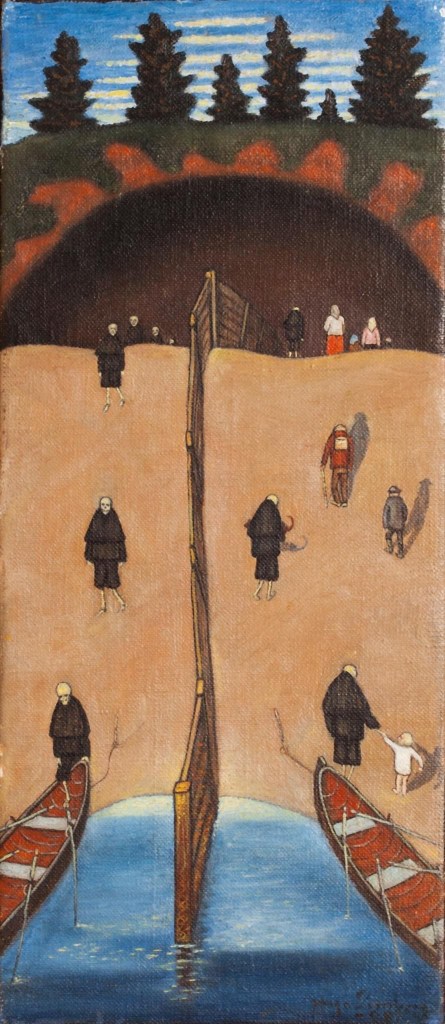
THE ENTRANCE TO TUONELA, 1898,
oil on canvas
Hugo Simberg, 1873-1917
Finland

Tuonela


In this piece, which is an interpretation of one of many universal myths which impart the water crossing and trek we all are to embark upon after death,

most of the departed climb up the steep, barren embankment and enter the tunnel individually, while a child and a dog are tenderly escorted — led by the hand or carried by chthonic monks into the tunnel leading to the

Underworld

the tunnel appears under geological strata — presumably the surface of Earth, with blue sky and forest in background above it

interestingly, the artist’s limited use of perspective also allows the sky and forest to be viewed potentially as the Great Beyond itself — as a Northern or Alpine “paradise,” a Valhalla, beyond the sojourn in and through the tunnel

a high, solid, wooden fence bisects the river, embankment and tunnel and prevents arrivals from observing the exiting monks — only one-way vision and traffic for the dead

and while the monks do not cast shadows, the human figures continue to be accompanied by their shadows; for those who subscribe to Jungian analytical psychology or gnostic texts, the physical shadow depicted may be interpreted symbolically as the anima/animus of the person — which would ultimately disappear during the tunnel upon the full reintegration of the Self/Soul/Spirit

through re-unification with one’s divine twin (which is sometimes also called the cosmic/celestial twin or daimon) after having been separated during human incarnation and birth.


author’s note: 

i often and prefer to call the underworld aka afterlife “The Great Wide Open of the All” — which in my liminal gleanings is a supremely contented blackness of universal consciousness, devoid of thought or sensation — a perfected existence in the dark cosmic fabric of nothingness,

there may be levels in the afterlife which may manifest our own personal imaginal constructs of paradise — far beyond what our limited sensory perception and experiences of life on Earth are - such as, an Alpine Paradise upon emerging from the tunnel -

i know full well the breathtaking beauty and feeling upon exiting a scary and lengthy mountain tunnel where my heart and eyes are stunned by a grand vista of forest, peaks and sky — from my many road trips in the Western U.S.

yet, i truly prefer the former — when i die, i want to rest for all eternity — although with just one desire, one sensation: warmth.

Continue reading “art appreciation: thresholds”

song[s] of my self: epigenetic lamentations

During the summer of 2017 – a time of significant change in my life – including the rupture of my marriage, an upcoming “milestone” birthday, and a relocation to a quiet rural place with dark skies and an abundance of fauna and flora — I literally heard myself: I had unconsciously begun a meditative practice of singing or humming verses and melodies of sorrow, wonder, gratitude — or simply, of the mundane. They were autonomic and presumably original, lamentations.

then, serendipitously, I retroactively encountered a May 2017 piece published in Yes! magazine about the revival and history of “lament singing” in Finland.

To find that I was unconsciously, but actually, participating in a Finnish tradition that I had never experienced or even heard of — but that was somehow still within in me — in some cellular, trans-generational or ancestral place — felt like a bridge to my lineage — to all my unknown women-kin.

The lyrics and tunes occurred spontaneously over several months, and I often automatically repeated the same one over and over while working, cleaning, cooking, gardening, walking or driving. I sung or hummed them mostly while alone, but sometimes they would emerge aloud in public places — and I didn’t even realize that I was in song or know how long I had been doing it.

People who laugh, cry, sing and talk to themselves aloud in the street are not “crazy — we are comforting, raging, celebrating, mocking and mourning ourselves, our lives, our experiences and the world.

Continue reading “song[s] of my self: epigenetic lamentations”

Cronehood: the imperative, work, province and privilege of becoming truth and living truthfully in the depths

Ageing is no accident. It is necessary to the human condition, intended by the soul. We become more characteristic of who we are simply by lasting into later years; the older we become, the more our true natures emerge. Thus the final years have a very important purpose:

the fulfilment and confirmation of one’s character.

- James Hillman

“Life is a farce if a person does not serve truth.”

- Hilma af Klint

“A crone is a woman who has found her voice. She knows that silence is consent. This is a quality that makes older women feared. It is not the innocent voice of a child who says, “the emperor has no clothes,” but the fierce truthfulness of the crone that is the voice of reality. Both the innocent child and the crone are seeing through the illusions, denials, or “spin” to the truth. But the crone knows about the deception and its consequences, and it angers her. Her fierceness springs from the heart, gives her courage, makes her a force to be reckoned with."

— Jean Shinoda Bolen

portrait of a crone
by a queen crone,
Lajuana Lampkins

"Women's most feared power over men is the power to say no. To refuse to take care of men. To refuse to service them sexually. To refuse to buy their products. To refuse to worship their God. To refuse to love them. Every therapist knows that sex can be forced, but no power in the world can force love from any woman who wishes to withhold it."

- Barbara Walker

“The Crone has been missing from our culture for so long that many women, particularly young girls, know nothing of her tutelage. Young girls in our society are not initiated by older women into womanhood with its accompanying dignity and power. 

Without the Crone, the task of belonging to oneself, of being a whole person, is virtually impossible.”

- Marion Woodman

Continue reading “Cronehood: the imperative, work, province and privilege of becoming truth and living truthfully in the depths”

Remember thy Self to keep holy

“You was blind to Him as your footprints in the ashes, but He saw you.

Beneath every disguise; in every gesture false or true; every silent resentment – He saw you in those dark corners. He heard you. Oh my brothers, He heard those thoughts.

Now, I am here today to talk to you about reality. I’m here to tell you about what you already know.


This, all, — this, is not real. It is merely the limitation of our senses which are meager devices. Your angers, and your griefs and your separations, are a fevered hallucination, one suffered by us all, we prisoners of light and matter…


Our faces pressed to the bars, lookin’ out, lookin up, askin’ the question, beggin’ the question — “Are YOU there?” Would that we had ears to hear – because every moment, every now — is an answer; every beat of every heart, every second of every minute, every minute of every hour, every hour of every day — is an answer.

And the ANSWER is: “Yes. Yes. Yes.”


Your sorrows pin you to this place; they divide you from what your heart knows…

And we bandage our soft selves in hardness and anger.


You are a stranger to yourself, and yet He knows you… And when your hard heart made you like unto the stone and broke you from His Body — which is the stars and the wind between the stars — He knew you. He knew you – yet and forever. How could the Father forget His children; how could the world forget itself?

Doesn’t matter that the children do not understand what they are. Doesn’t matter that the world thinks that it’s many different things — rather than One – HIM. Doesn’t matter.

My sad and joyous, and frightened and courageous brothers and sisters,

I want you to close your eyes and let your chest swell as His lungs; I want you to feel His Portion in us – in each other.

Every single one of you, I want you to listen for that answer:

If ever your sorrow becomes such a burden that you forget yourself – forget this world, I want you to remember this truth, this is as indelible as the sun in the sky and the ground beneath your feet:


This world is a veil, and the face you wear is not your own.


The shape of our true face is not YET known to us.


And so I press my eyes to the bars, and I look out, and I look up — and I ask the question, no! I BEG the question: Jesus Christ! Jesus Christ! – Your arms open and close, and the echoes of my life could never contain a single truth about You. You move the feather and ash, You touch the leaf with His flame, You linked Your soul to an Infinity of atomic creation, and of It – I am less than a drop in the ocean. How then can I know sorrow, how then, can I know despair? – Does the rain know sorrow, does the grass and the mountains, those beautiful mountains, know despair?

Such is not His Province, and so not be our purpose.

Be in Him, of Him, and then KNOW peace; that is His gift to us — our birthright.

In the End, we will find ourselves at the Beginning. We will at last KNOW ourselves; and our True Faces will weep in His Light – and those tears will feel like a warm rain.

Amen.”

Continue reading “Remember thy Self to keep holy”

Crone Consciousness


I could not live in any of the worlds offered to me…the world of my parents, the world of war, the world of politics. I had to create a world of my own, like a climate, a country, an atmosphere in which I could breathe, reign, and recreate myself… That, I believe, is the reason for every work of art. The artist is the only one who knows that the world is a subjective creation, that there is a choice to be made, a selection of elements. It is a materialization, an incarnation of his inner world.

Anais Nin

Here she stopped and, closing her eyes, took a deep breath of the flower-scented air of the broad expanse around her.

It was dearer to her than her kin, better than a lover, wiser than a book.

[For a moment] she rediscovered the purpose of her life.

She was here on earth to grasp the meaning of its wild enchantment and to call each thing by its right name …

Boris Pasternak, Doctor Zhivago

As soon as you are really alone you are with [the] God[head].

Thomas Merton