One experience of living rurally — without any obstructions of buildings or infrastructure — and with a full southern exposure out my front door, generous windows and an unencumbered view of all four cardinal directions — it’s like i am in the center of a beautiful compass at all times — is, that i have been able to observe and better understand the obliquity of the ecliptic:
marking the farthest northeastern point of the Sun’s eager rise and the farthest northwestern point of the Sun’s leisurely set at the Summer solstice with my own eyes — the Sun making a deep, high horseshoe arc on those long Summer days,
and to watch the Sun’s progression/regression daily,
and, to witness how at the Winter solstice, the Sun just sleeps in, lazily rising in southeastern Sky, just barely making an appearance for us in the northern latitudes — offering us the shallowest, little arc of light before quickly bedding down again in the southwestern Sky;
Darkness is so precious in the Summer and the light is so precious in the Winter. The darkness is so gloriously abundant in the Winter and the light is so gloriously a abundant in Summer;
i am so grateful and privileged to have experienced this solar panorama and time lapse in real life for eight years now, after living many decades in a major North American city — Chicago, without it;
and,
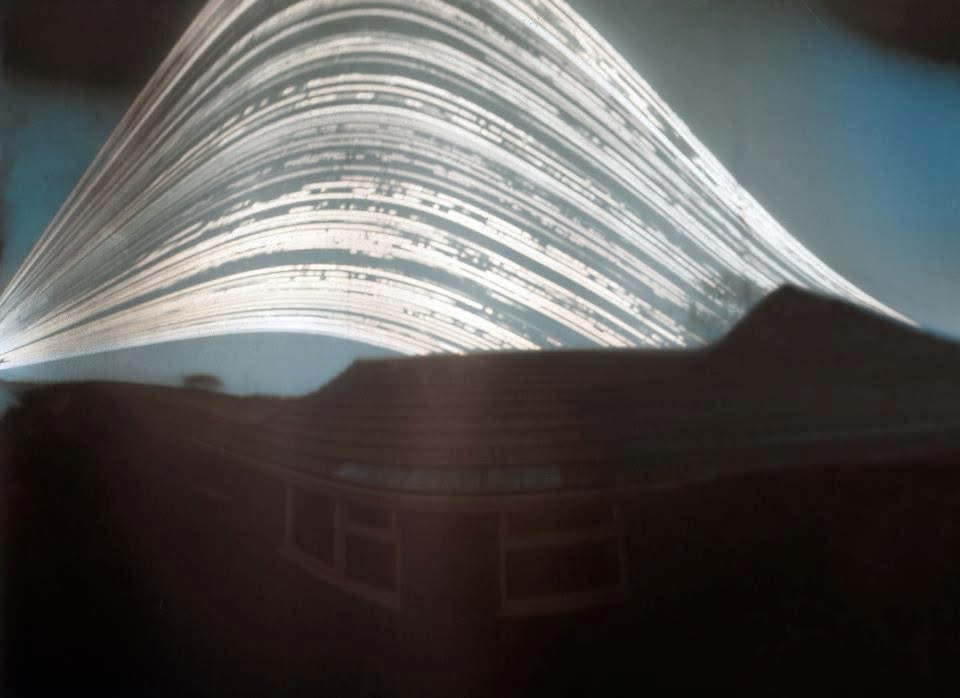
below is my favorite ever foto to share on the Solstice: Attila Kálmán faithfully and wondrously captured the obliquity of the ecliptic — his camera tracking the Sun’s path from a point on the Northern Hemisphere of Earth from Summer to Winter Solstice in 2012.
photo by: Attila Kálmán, h/t to Earthsky, 2012. Perfect for explaining our Sun, axial tilt and seasons to a child (or to a white American adult).
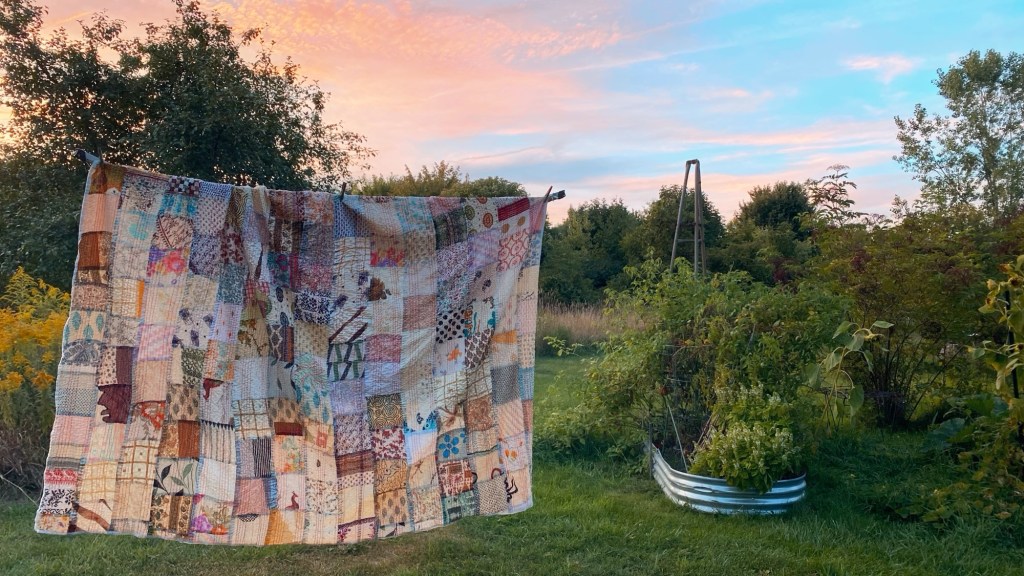
and a few of my own favorite Summer Solstice experiences:
a version of this essay was first published December 8, 2015
“Christmas is coming,
the goose is getting fat,
please put a penny in the old man's hat,
if you haven't got a penny,
then, a half-penny will do,
if you haven't got a half-penny,
then God bless you.”
I went to the nearest Dollar Store to buy old-fashioned, stringy, silver tinsel for our christmas tree.
All that glitters is not silver or gold, is never ever golden, whether you buy your pretty ornaments or wrapping paper for a buck – or two at Dollar Tree, Walmart, Target, Macy’s or Saks for $5, $10, $30 or $50. The only difference is the retailer’s profit margin — very rarely is there a difference in quality when it comes to seasonal items, disposable items and sundries.
The season of peace and beauty feels very false once you know and remember to never forget that all those beautiful ornaments and decorations adorning almost every American home, restaurant or holiday venue are made by women, children, or men in sweatshops who are breathing in lead dust, paint fumes, plastic glitter, chemicals and pigments often for less than $30 per 12-hour shift; all that beautiful crap then warehoused, shipped, stocked and sold by non-living-wage, multi-job workers in the U.S.
Yet, while I’m there roaming the aisles or in the long line to check-out, I feel an overwhelming sense of community with my fellow city dwellers — the shoppers, the store’s workers and with all the workers of the World — particularly those in Yiwu, Zhezhang, China who are mass-producing a vast majority of all of this shit.
silver tinsel, aka Icicles, ironically & hilariously, still made in the USA!
I also feel an overwhelming revulsion of the systems of ‘growth’ and development: capitalism, consumerism, and human and natural resource “management” which are uniquely undeniable in the fluorescent, depressive uniformity of the minimally staffed chaos found in a busy, urban dollar store,
fresh snow, a perfect medium for the long shadows cast by the house & black walnut tree, under the high and full Snow Moon of predawn february 24, 2024
please FEED THE WILDLIFE! if you have means to do so — to help our Earthling kin survive and thrive in the extreme temperatures and conditions of winter and summer — and during fall and spring migration
why is this radical?
because we have been instilled and warned to not do this!
but we now need to feed the wildlife we share habitat with — precisely because we’ve destroyed so much of their own habitat — and their preferred and once-abundant wild food and water sources
(but please only set out food for those wild kin who visit or inhabit your yards, balconies, patios or city parks – still, never feed our more-than-human kin in wilderness, or national, federal, state or county parks, forests, natural areas or preserves)
A charcuterie board for resident Crows in their favorite spot to feast — the stone slab footprint of a former barn.
This Hydrangea nostalgia bush was grown from a 2017 autumn cutting from its parent which is, or was, located in the front yard of my brick 2-flat in the northwest side neighborhood of Portage Park in Chicago. One of a half-dozen or so white hydrangeas planted by me in the late 90s, I had nurtured and obsessed over them for nearly 23 years — this one is now the lone survivor in my care at my rural home in Michigan.
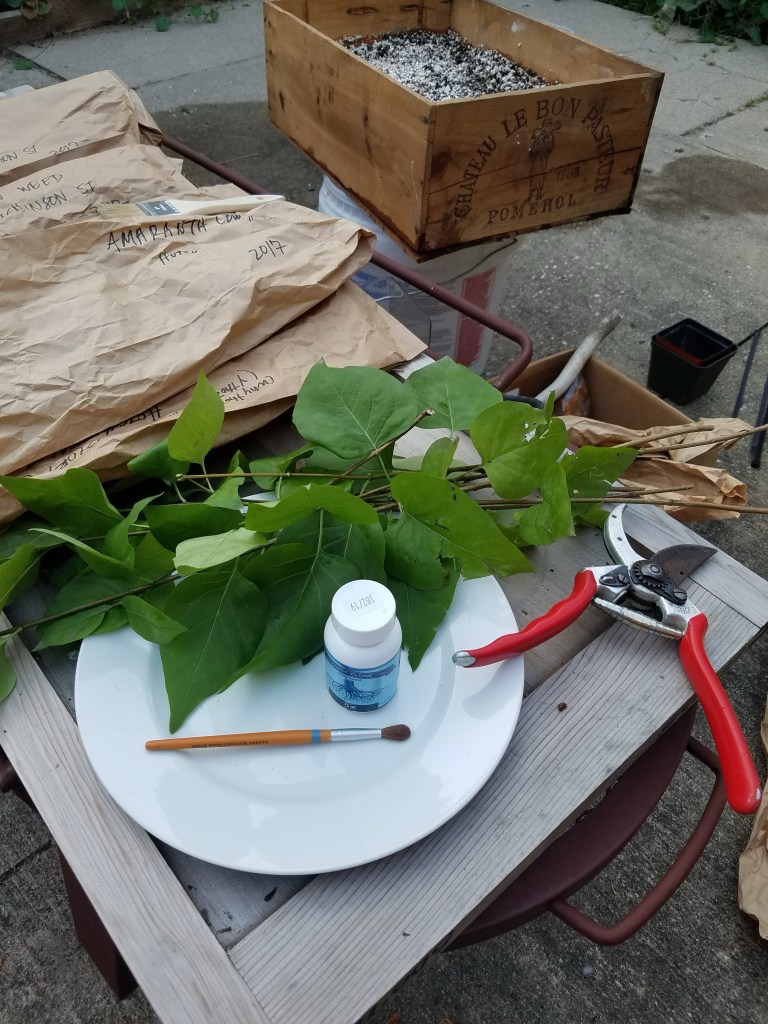
lilac cuttings, rooting hormone solution, and growing medium, September 23, 2017 (not even one of these most precious lilac cuttings rooted and survived)a box of hope. autumn hydrangea & lilac cuttings, not ideal for propagation, but ready for transport and transplant to Michigan
But the genesis of my city girl hydrangea devotion was not Martha Stewart’s ubiquitous “Living” magazine, also of 1990s — though she certainly named, informed, inspired and validated many a hydrangea obsession within those pages — rather, it was the nostalgic ubiquity of enormous white snowball blooms and arresting blue-purple poms on heritage shrubs that I admired, coveted, played and hid among during my childhood summers spent with my maternal grandparents in Murphysboro — a sleepy, rural town in Southern Illinois — where my maternal great, great grandmother, my great grandmother and grandmother were all born.
I was entranced by those plants each summer — yet without the language to name and fully describe them to my mother when I returned back home to the Chicago Housing Authority’s Lathrop Homes aka “the projects” – which usually, was just in the nick of time for back-to-school in late August. Interestingly, I don’t recall ever drawing a picture of hydrangeas or taking a photo of them with my hard-earned Kodak Instamatic pocket camera as a child – even though I frequently used both methods to capture/record my favorite things. //
“Nostalgia Kills”
Nostalgia is a psychologically pining for a sweeter but largely false time in our lives — a naive, shallow or ignorant time that we prefer to, that we choose to, remember as “innocence” or romanticize, idealize or distort as the “best times of my life” or the “good ol’ days”.
Instead of thoroughly revisiting the entirety of the time, place, people or experience, nostalgia often robs — or kills — the opportunity for true introspection and material dialectics. ///
early July 2023
Nostalgia sounds like the name of the a psychological condition catalyzed by avoiding “dis-ease”








 the limineen | earthling, poet & crone